Forgiveness isn’t a word often used these days. And when it is, the pain we feel from the trauma or betrayal goes too deep to even consider. Yet, I’ve learned that stuffing doesn’t fix anything.
I’ve learned from experience that stuffing is not equal to healing. Eventually the stuffing begins to ooze out all over the place, much like that suitcase I filled too full. As my suitcase is jostled and dropped, it eventually busts wide open to expose everything I wanted to stay hidden.
BEFORE I BEGIN
I’m not a professional, and I understand that healing from trauma and betrayal may require time and professional help before forgiveness is possible. With that, I have experienced the internal peace that comes with forgiveness.
Also, if you currently live in trauma without safety, I pray that God would move on your behalf so you may see his care for you and experience his power at work on your behalf. Please don’t stay there once you see the way out!
I also pray that God grant you someone to help you navigate the pain you’ve endured so that you can begin to heal. If you have sought help and have had little relief, there are many stories of people whom God has healed from PTSD.
I too have experienced his healing from PTSD over time and have shared pieces of my story in other posts. Because of my own need in the last year to heal and make choices regarding forgiveness, I have done a lot of soul-searching and some study on forgiveness–what it is and what it isn’t. I have become greatly aware that to find healing eventually requires the choice to forgive. But first let me clarify what I mean by forgiveness.
Never means you need to stay with or return to the perpetrator so they can continue to abuse. Safety is never ignored by true forgiveness. (Church leaders should NEVER advise anyone to stay with an abusive spouse or parent in order “to submit and forgive”.)
Doesn’t assume a time-frame. (If the events caused deep emotional wounds or trauma, you may need outside help to process the events and your emotions/trauma to be able to forgive.)
FORGIVENESS ALWAYS ASSUMES
The perpetrator doesn’t deserve forgiveness.
The choice to forgive is for the benefit of one emotionally wounded or traumatized to find inner peace and healing.
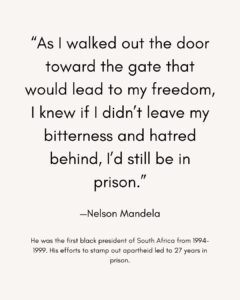
“I refuse from this time forward to be emotionally enslaved to the one who traumatized me.” (Refusal to forgive keeps the traumatized emotionally chained to the perpetrator and events that traumatized.)
SCIENTIFIC STUDIES ON THE POWER OF FORGIVENESS
As I researched for this article, I found many quotes both for and against forgiving those who’ve deeply wounded you. I also read about overwhelming scientific evidence (abstract by NIH, Harvard Medical School, Johns Hopkins Medical School) that suggests that the choice to forgive benefits the forgiver.
Practicing forgiveness can have powerful health benefits. Observational studies, and even some randomized trials, suggest that forgiveness is associated with lower levels of depression, anxiety, and hostility; reduced substance abuse; higher self-esteem; and greater life satisfaction. Yet, forgiving people is not always easy. From “The Power of Forgiveness” February 12, 2021, Harvard Health Publishing, Harvard Medical School
Faith Gateway article from the book by Eric Metaxas, “7 Women and the Secrets of Their Greatness” entitled, “The Test Of Forgiveness.” The article is about Corrie ten Boom, an Austrian Holocaust Survivor whose family harbored Jews in their home before being caught and sent to the Ravensbrück concentration camp.
Maybe you’re thinking one of these scenarios right now:
“But I can’t forgive.”
“I’m still suffering from what they did to me.”
“What they did was too horrific to be forgiven.”
“They still don’t care about what they did to me.”
“But you have no idea what you’re asking me to do.”
To say I understand would be cruel. I can’t even list all I’ve faced and use my life’s experiences as reason for me to sit here and tell you I understand.
Yet, as I contemplate the events of my own life and the pain I’ve experienced even the last year, I’m realizing forgiveness plays a huge role in my ability to experience lasting inner peace and healing.
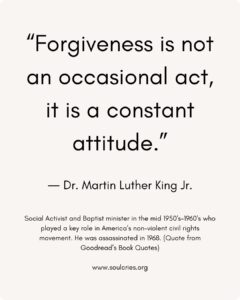
Please don’t throw out the idea of forgiveness without taking time to consider what you have read here. Forgiveness is meant for you to flourish.
BUT WHAT IF I’M THE ONE WHO NEEDS FORGIVENESS?
You aren’t alone. Every one of us, including me, have been in this place of needing forgiveness. That’s why God’s Word states that:
Christ suffered and died for sins once and for all–the innocent for the guilty–to bring you near to God by his body being put to death and by being raised to life by the Spirit. 1 Peter 3:18 TPT
I sat in the congregation while praise music blared as one-by-one young and old testified of their new life in Christ through baptism in the pool set up at the front of the church. Suddenly I noticed a middle-aged man I knew enter the pool followed by a young man whom the older man was readying to baptise. I had heard the story of how the older and younger had met and sat with tears streaming down my face as I witnessed extravagant love.
The older man and his wife had lost their son several years before to a drunk driver. They decided that rather than live in rage at what had happened, they would choose to forgive. Not only that, they decided they wanted to meet this young man who had squandered their son’s precious life through a moment of sheer stupidity and self-indulgence. They were granted permission to meet their son’s murderer, and share their hearts to forgive. They spent time with this young man over the next several years. Moved by their love, the young man decided to give his life to Christ. This particular morning, as both father and murderer stood together in the baptismal pool, a new family was born and hundreds got to witness extravagant love. Love like Jesus.
WHAT IF THE ONE YOU NEED TO FORGIVE IS GOD?
Talk to him about it. He’s seen your heart all along and would want you to dialogue with him about it. It won’t hurt, and could help. Also, if you’ve been wounded by someone who identified themselves with God, they aren’t God. There are plenty of people who misrepresent him every day. Talk to God about them as well. God longs for you to find restoration with him through Jesus.
STRUGGLING WITH THE PAIN OF FORGIVING
Corrie ten Boom was an Austrian Christian who’s family hid Jews during the Pogroms in Austria. Her father and sister died in concentration camps, and she survived Ravensbruck. This is her story of struggle:
BIBLE BITES REGARDING FORGIVENESS
“Who is a God like you, who pardons sin and forgives the transgression of the remnant of his inheritance? You do not stay angry forever but delight to show mercy.” —Micah 7:18
“If my people, who are called by my name, will humble themselves and pray and seek my face and turn from their wicked ways, then I will hear from heaven, and I will forgive their sin and will heal their land.” —2 Chronicles 7:14
“Be kind and compassionate to one another, forgiving each other, just as in Christ God forgave you.” —Ephesians 4:32
MAY I PRAY FOR YOU?
Father, I know what it’s like to hurt so badly that the thought of forgiveness makes me feel like throwing up. Yet, I’ve also felt the freedom of finally choosing to forgive. Would you please comfort this one who now struggles? Would you reveal your heart toward them and what they’ve been through? Would you come now and intervene on their behalf to help them do what they cannot on their own? Thank you, in Jesus’ name, amen.
Anxiety. That sense of electricity uncontrollably coursing through my body. Feeling like I want to crawl out of my skin but can’t. Agitation I can’t walk away from. It’s tormenting.
In 2007, as I faced my husband’s impending death, anxiety struck the first time like lightning. The storm lasted six to eight years, striking multiple times daily, every day like poor Ned Ryreson reliving Ground Hog Day. It took time to understand what in the world I was experiencing, and that I wasn’t going mad. It also took a lot of time for God to instruct me how to harness anxiety and restore peace.
It’s been a while since I have dealt with anxiety like I did in those days. I’ve experienced small squalls since, but within the last several months, anxiety has tried to batter me once again to where I’ve wanted to crawl under a rock and escape. Once again faithful God is teaching me how to subjugate this beast and restore peace. Since we all have moments when anxiety and fear rage, allow me to share with you pieces of my journey and my transformations to peace.
I’m not a professional but do know anxiety
I have a lot of experience with anxiety over many years, and it is from that pool of experience that I write and remind myself of how far I’ve come.
As I researched this post, I learned of Dr. Caroline Leaf, a Neuroscientist who has spent her career studying the plasticity of the brain. She states that anxiety and its associated emotions aren’t meant to be accepted as “normal” forever, but to be tools to expose areas of our lives needing assistance so we can live healthy lives.
Our culture is obsessed with Social and digital media as we crave greater amounts of information. Yet, with all we allow ourselves to take in daily, both pleasant and stressing, society in general is beginning to show signs that something is wrong.
“The use of social networks is strongly correlated with the development of anxiety and other psychological problems such as depression, insomnia, stress, decreased subjective happiness, and a sense of mental deprivation.”
Neuroscientists are learning that unbridled negative emotions/circumstances and their corresponding thought patterns build toxic pathways in our brains much like deformed roots and branches of a tree. In addition, they are also learning that we can retrain our brains to shut off the spiraling thought patterns that help produce chronic anxiety and depression.
We all have choices, and can choose patterns that avoid or heal chronic anxiety. Who and what I listen to is critical for my mental health and for retraining my brain toward more healthy pathways. If the majority of my intake only encourages and affirms my anxiety, depression, and negativity, I’m feeding myself poison.
I was recently told that someone, whom I love deeply, realized that much of her anxiety was caused by what and who she listened to, and that once she stopped all the toxins coming in, she began to see life with greater positivity. Several of the above reports suggested limiting social and digital media usage in order to improve mental health.
After my first husband’s death in 2008, what I listened to helped to decrease grief and anxiety
Instead of listening to music that “understood” and “affirmed” my grief and anxiety, I chose music that reminded me that I was understood and upheld by the God who made and loved me, that I didn’t walk alone, and that God had good plans for my future. Rather than becoming further depressed, the music improved my mental health. I’ve heard many testimonies from others who also chose to listen to Christian music for 30 days, and that it changed their outlook on life. KLOVE is an excellent starting point.
I made time to sit with my pain and acknowledge the loss with Jesus as my companion, rather than allow anxiety and grief to spiral over and over in my head. I listened to Jesus’ voice and comfort over focusing on the grief, anxiety, and loss I felt. The space I made to grieve allowed me to heal sooner, and offered me greater peace as I navigated this new season of life.
I surrounded myself with people who could offer hope and instruction as to how to navigate this new stage of life. I attended a local GriefShare group that surrounded me with people who understood. The accompanied grief training also taught me that my grief experiences were normal, and helped me navigate this new life with greater peace. Both the people and training equipped me to understand my grief so I could heal, offering less space for anxious thoughts to take precedence. GriefShare has chapters throughout the US and also has a web presence if you live outside the US.
After remarrying in 2012, a trauma counselor helped tremendously with anxiety
My newly blended family struggled with the traumatic loss of their former wife and mom two years before. Also, I was now the third mom to not only my adopted son, but now two step-sons who had also been adopted. Life wasn’t easy for any of us as we navigated to blend our family. in addition, I continued to deal with the anxiety associated with my first husband’s death. Pain clashed with pain and sometimes triggered old wounds and created new ones.
I finally realized I needed assistance to work through the trauma, and so my pastor recommended a Christian trauma counselor. She affirmed the trauma by acknowledging that I wasn’t exaggerating the struggles. She also spoke truth, hope, and life into our situation, and gave me sound advice as to how to express my heart, needs, and emotions so my husband could better understand. This time with her gave me tools, hope, and a healthier way forward, and broke down opportunities for anxiety to continue to rule.
After about four years of marriage, things began to calm down significantly, and I had healed enough that the anxiety no longer had a hold on me. I was grateful for the morning I awoke, and anxiety wasn’t the first emotion I experienced. I was finally beginning to feel safe.
During COVID we invented new practices to guard against anxiety
Covid, for the most part, is behind us. Yet the effects are still among us. What I learned from that time still affects what and who I listen to today.
I cut off most of the news and social media as it was having a negative impact on my mental health. I still hold to this practice. My life is much more fruitful because I don’t spend hours listening to and reading about things I have no control over. So when I interact with the pain of others within my world, I have a greater pool of energy and compassion to give. My impact is increased because I’ve not given my emotional energy to things outside my sphere of influence.
My husband and I began a practice then that we still hold to today – we often spend time near the end of the day listening to and singing contemplative worship and praise music that lifts our eyes from the events of this world to God’s realm among us. It calms and soothes me from the effects of daily life, and often eases any anxiety that I may be facing with his peace.
The role the Bible plays in my mental health
Reading my Bible daily is critical to my mental health. Below are some helpful steps to begin and maintain a reading plan:
Pray for God to reveal his love for me
Don’t begin with Genesis or Matthew
Good starting places – the Psalms (reveals God’s understanding and compassion) and the gospel of John (reveals God’s love and power through Jesus)
Read a newer translation such as the NIV or NLT. King James was a wonderful translation for its time, but the archaic language makes it difficult to understand today
Read until something about God’s love, or a positive course change sticks out to you. That may be God speaking to your heart
Respond to what you read – Pause, consider, record what you recieved, and talk to God about it
A taste from God’s Word
The Bible simply speaks to the wisdom of guarding what I allow into my mind, and the positive benefit of doing so:
…whatever is true, whatever is noble, whatever is right, whatever is pure, whatever is lovely, whatever is admirable—if anything is excellent or praiseworthy—think about such things. Whatever you have learned or received or heard from me, or seen in me—put it into practice. And the God of peace will be with you. Philippians 4:8-9 (NLT)
A Prayer of Hope
Lord, you have brought great healing into my mind, body, and spirit, so I ask you to do the same for this dear one. Your love for them surpasses knowledge. May you grant them the trust they need to reach out to you. In Jesus’ name, amen.
Our world regularly decries the God of the Bible as at least a myth, and at most a monster, begging the question, “Why would anyone choose the Bible?” This article takes the stories of those who chose to follow the God of the Bible despite the odds.
NATIVE AMERICANS CHOOSE JESUS CHRIST DESPITE PERSECUTION
My husband pastors a small rural church comprised of mostly Native American followers of Jesus. They choose to follow Jesus Christ despite generations of oral stories proclaiming the atrocities of being forced to convert to “Christianity”. This time no one forced them.
Some congregation members tell stories about a time prior to choosing to follow Jesus. They readily joined in with family members who mocked those who followed Jesus Christ. Years later, finding no hope themselves, they too cried out to Jesus and discovered why their relatives had been willing to endure persecution for their faith. They too now suffer willingly for their faith in Christ.
Why would people choose to leave their Native religion and face persecution to follow Jesus Christ?
A YOUNG MAN CONTEMPLATING SUICIDE EXPERIENCES INSTANT TRANSFORMATION
As a child, my husband’s parents would send him and his siblings to church but they didn’t attend. There he would hear about the love of Jesus that included the realities of hell. Once he got into high school, however, he stopped attending church regularly, rejecting all he’d been taught as a child.
At the age of nineteen, a severe breakup with his fiancé left him suicidal. He recalls that those Sunday School stories of hell kept him from driving into bridge abutments “moments before steal hit concrete”.
Unable to find relief, in desperation he finally cried out to God, “If you’re real, just give me a reason to live and I’ll do anything for you!” Instantly he felt an overwhelming peace. He soon found a Bible-believing church who loved and taught him the Word. He grew in his faith and eventually went into the ministry.
How could someone’s life be so dramatically changed in an instant?
POST TRAUMA, FILLED WITH QUESTIONS, HE CHOOSES GOD AGAIN
My husband and his first wife spent twenty-six years together in ministry. In their twentieth year of marriage, his wife’s health began to deteriorate, and after six years of illness she passed away one night while he was at work. He found her the next morning, his boys waking to him screaming her name over and over as he attempted to revive her with CPR.
Having seen people miraculously healed throughout their years of ministry, he strongly believed she too would be healed. So when she passed, he experienced intense doubt and questions to the point that he left the ministry. Although he struggled with feelings of abandonment by God, he now states that he also found solace in spending time with God through prayer and worship.
Two years after her death, and four years after the death of my first husband, Gary and I were married.
Years later Gary realized that as her health failed and his workload intensified, he spent far less time in God’s Word, the Bible, which contributed to his “crisis of faith”. He now believes that had he spent more time with God’s Word back then, his crisis of faith would not have been as severe. Not because God was angered, but because he now realizes that his time with the Lord may have strengthened him during those extremely difficult year after her death.
A year ago, God opened a door for us to return to ministry. Gary now readily proclaims that although he still has questions, serving God fulfills him as much as it did before his family’s trauma.
Why would someone who’s endured such trauma choose to serve God after all they’ve been through?
WHY I DAILY CHOOSE TO FOLLOW JESUS
My life experiences have included:
Feeling desperately alone as a teenager
Losing my rock and comfort of twenty-five years of marriage to cancer at forty-eight years of age
Experiencing intense loneliness while raising a child with autism and mood disorder
I experienced such feelings of loss and depression in my pre-teen years, that had I not already known Jesus, I wouldn’t have made it. I have often said that without Jesus I would have either committed suicide, ended up on drugs, or flung myself at any man that came along. Throughout the loneliness that wracked the years I raised our son with autism, and then through the pain of losing my husband, I also was able to remain steady through the peace and presence of God. Had Jesus not chosen me as a child to walk with him, and had I not chosen throughout life to continue to walk with him despite the intense pain, I would have a very different life now. I seldom deal with depression and anxiety. I feel fulfilled. I continue to grow in my relationship with the God who loves and cares for me.
God longs for you to experience the transformed life through Jesus Christ that we have found. A life worth living despite the trials and struggles. I would even say that if this interests you at all, he’s calling you to cry out to him for help.
Maybe you’ve cried out to God before, to no avail. Would you now be willing to yield as my husband once did when he cried, “God I’ll do anything if you’ll give me a reason to live”? Why not try? If you’re willing to honestly yield as Gary once did proclaiming, “if you’re real, give me a reason to live and I’ll do anything you ask” God will listen and respond. Jesus said so right here:
“Come to me, all you who are weary and burdened, and I will give you rest.Take my yoke upon you and learn from me, for I am gentle and humble in heart, and you will find rest for your souls.For my yoke is easy and my burden is light.”
Wish to read more about this Jesus and my story with him? Here are a couple more articles to consider:
I have also written at length about my experiences raising our son in a chapter of “Life Repurposed” by Michelle Rayburn. My story is found on page 123 “God in My Loneliness”.
You may find comfort from this article about Jesus’ interactions with two blind men who desperately wanted their sight.
Interested in a brilliant, mobile responsive website that converts?
We can make that happen.
Stormhill Media is a web design and social marketing company with the goal to provide you the best and most affordable website solutions for your online brand.










Recent Comments