Cutting is a coping mechanism that hides behind the scenes, and someone I care deeply about uses cutting to deal with their pain.
I AM NOT A PROFESSIONAL. This article is based upon personal experience and research.
Why I Wrote An Article On Cutting
I hope to start much needed dialogue within families and churches. Our kids need safe places to share their pain, and parents and church leaders need to be aware of the problem and become equipped to respond with compassion and wisdom.
Parents and church leaders also need to be able to:
Institute measures to help youth and families avoid such struggles and pain. (I’ll speak more to that later in the article.)
Assist families and youth to offer hope and healing.
Research on Cutting and Self-Injurious Behaviors
For those into hard-core research, NIH has a very exhaustive study about self-injurious behaviors. If scientific reading isn’t your thing, (I didn’t read the entire article as it is quite technical) I’ve highlighted some less technical articles in blue. (To access these just click on the blue words throughout the article, for those new to blogs.)
Statistically, about 15-17% of teens cut. Stats for college students run 17-35%. Adults 5%. I saw more articles on teen averages than any other age bracket. Child cutting does occur, but children don’t cut or self-injure as much as teens or college students.
Reality is, cutting is often done in secret utilizing areas of the body that aren’t readily visible, so the averages could really be much higher.
Cutting isn’t the only self-harm mechanism. There is also head banging or hitting, burning, or objects such as the point of metal paper clips pushed under finger nails or into the skin, but these aren’t as likely.
Also, as our world becomes more emotionally charged through increased normalization of violence, I am concerned that the statistics of cutting and self-injurious behavior will also rise.
Why do people cut or self-harm?
This dearly loved person whom we know is very creative and can be very kind and thoughtful but “they” have also endured pain most kids and young adults should never endure. This person once said “they” cut because, “When I see the blood flow, it makes me feel alive. Most of the time I feel dead inside.” (I have changed pronouns and have left out as much information as needed to keep this person anonymous.)
There’s a myriad reason why people cut. One article I read likened it to those who choose to drink or do drugs to numb the pain. Science has proven that physical pain runs along the same neural pathways as emotional pain, so sometimes people cut to short-circuit emotional pain. Here are two articles to help you understand how this happens. (Again click on the article if you wish to read it.)
Click here for a professional list of reasons people gave for cutting.
What should I look for when I suspect cutting or self-harm?
For a professional list of signs to alert you that your loved one may be cutting or self-harming, click here. The main signs to look for are:
Wearing inappropriate clothing for the season to cover scars or wounds.
An unusual demand for extreme privacy, either by being very evasive or a suddenly unwilling to use the locker room at school.
Scars covering scars, or jagged scars that don’t match with the reasons given for them.
The make-up of your loved one’s friends or lack of friends.
Mood changes that include seeming secrecy.
If you have suspicions about your loved one’s injuries what should you do?
I’m certain our kids realize self-harm is an issue among their peers, but do we adults know what’s going on? Iit seems too horrendous to even consider. But we must become aware and have tools available to us, for the sake of our kids and the kids around us.
If you suspect something is wrong with your loved one, don’t waste time pretending nothing is wrong or that your child is just going through a phase.
Begin dialogue as soon as possible
A Harvard study (click here for the article) stated that asking about cutting won’t usually encourage cutting, but it will let the person know you care. Try to engage them in calm conversation. If you are unable to stay calm, ask for help from someone you trust. The most important things to remember are:
They need you to be able to listen calmly and compassionately without shaming or guilting them.
They need to know you care even if you don’t fully understand.
They need to know that there is hope.
They need encouragement to get help.
What to do if your child is a minor
Your loved one needs help. If they are a minor, get them to your primary physician, a psychiatrist, psychologist, or trusted social worker for an evaluation. The stats show that even grade school kids cut, not at the level of teens or college students.But if you see injuries that appear to show harm in a small child, don’t assume they did it to themselves. Protect the child by getting them to a professional as soon as possible, and be willing to call the authorities in your community if necessary.
Jesus’ centered resources in the US for people who are cutting
As a Christian and someone who has dealt with trauma in my own life, I found a Christian trauma counselor in my area who helped me deal with my trauma in a professional and God-centered manner. My husband is a pastor, and I know that if he was aware of a minor or adult cutting, he would want to come alongside, but would also highly recommend professional help.
I haven’t vetted these organization, but thought I’d give some resources I found online for Christian Trauma Counseling:
There are also a myriad of resources if you search “Christian Trauma Counseling.” The above article may give you some helpful information on what to look for and what to ask those with whom you speak.
For those looking for prayer ministry that has been successful in ministering to those with trauma, I have found healing from trauma using an inner healing prayer ministry called, Connect Up, in Pennsylvania. They are not listed as licensed counselors. They utilize ZOOM calls and in-person sessions, so anyone can utilize their resources. There is also a prayer ministry called “God Heals PTSD” that has been utilized by God to bring healing to thousands of people with PTSD.
How can we prevent cutting from happening?
We can’t fully, but we can be aware of the stressors in our loved-one’s lives that contribute. We can:
Build the relationships needed for our kids to feel comfortable about sharing their hearts both within the home and church setting.
Regarding minors, take notice of our children’s friends, and the amount of time they are on social media. Those who cut will share with peers who cut. Things spread.
Don’t assume because all looks good on the outside, or because they are active in church that things are always okay.
Jesus showed the most wounded great compassion without shame and judgement. Like Jesus, we must be lavish with hope and forgiveness, mimicking Jesus as he:
Spent time with a lonely and forgotten woman to whom he gave new life, John 4:1-42
Offered forgiveness and a new life to a woman accused of adultery, rescuing her from a religious group wanting to stone her, John 8:1-11
Gave new life to an emotionally, physically, and spiritually tormented man who had suffered many years, Mark 5:1-20
If we call ourselves by Jesus’ name, we are commanded to do the works Jesus did and saw his Father doing. (John 14:12; John 5:19-23)
Jesus offers hope for the wounded and their families
I’m encouraged that the Bible doesn’t refrain from discussing anything, including uncomfortable topics. If the Bible covers the easy and the hard of life, we too should be willing to grow in our understanding of the social pressures our kids endure, and engage them with compassion, understanding, and hope–with all the wisdom God offers.
Our kids also need to know that the God who knit them together in their mother’s womb (Psalm 139) cares deeply (1 Peter 5:7) and calls them to into a dialogue with him, as seen throughout the scriptures. I recently read the following Bible verses and the Holy Spirit said to share them. These words have encouraged people for centuries to cry out to God who has responded with peace and power. God invites you to do the same.
Out of the depths I cry to you, Lord; Lord, hear my voice. Let your ears be attentive to my cry for mercy.
If you, Lord, kept a record of sins, Lord, who could stand? But with you there is forgiveness, so that we can, with reverence, serve you.
I wait for the Lord, my whole being waits, and in his word I put my hope. I wait for the Lord more than watchmen wait for the morning, more than watchmen wait for the morning.Psalm 130:1-6 NIV
Finally, as parents and church leaders, when we step into the uncomfortable with our kids, we too may need someone to talk to. But be wise. If our kids trust us enough to be vulnerable, we need to respect them enough to maintain confidentiality.
You may need to get council and prayer support, but be very discrete and wise as to with whom you share, and what you share. This situation is never “prayer request” material for Bible study night. The last thing our kids need is for the whole church, men’s study, or women’s prayer group to know and continue to “share the need of sister or brother so-and-so”.
Should you want someone to speak with, please email me, or leave a comment. Any conversations will remain confidential unless you or someone you know wants to hurt themselves or someone else.
Have you ever wondered if God hears your cries and wants to come close to offer you comfort and hope in your need? He does.
My cries for God to come close and comfort my friends in their loss
In the last three weeks I have cried out to God to come down and meet dear friends as they face the grief of losing their daughter and sister to cancer. My husband now prays God to come down close on behalf of a dear friend who’s brother lost his final battle with cancer. I often cry out for God to come close, and have often experienced his reply by drawing near to me in my pain.
I found this song a few weeks ago, It gives words to my pain and cries for God to come close and meet me here. (Emmanuel, also spelled Immanuel, is a Hebrew word used in both the Old and New Testaments describing Jesus as ‘God with us’.)
Do you need God to come close and meet you in your pain?
Maybe your struggle isn’t the pain of death. Maybe your cry is because of abuse, abandonment, or neglect. Maybe it’s anxiety or depression, or thoughts of suicide. Maybe it’s an addiction that dulls the pain caused by an unfaithful partner, or shame and guilt that won’t go away. Whatever has caused your pain, you need to know that God isn’t far away and that he longs to come close and meet you in your space.
I have experienced his nearness and his comfort as my first husband and I raised our adopted son with non-verbal autism. I experienced God’s gentle care through the death of my husband. I’ve felt his presence through church hurt. He’s met me in very personal ways when going through deep rejection. I’ve felt his nearness and peace while my body rebelled against a tumor inflicting much physical anguish several years ago.
God’s heart to come close to you
In his first sermon, Jesus explained why he came:
“The Spirit of the Lord is upon me, for he has anointed me to bring Good News to the poor. He has sent me to proclaim that captives will be released, that the blind will see, that the oppressed will be set free, and that the time of the Lord’s favor has come.
Luke 4:18-19 NLT
This Old Testament prophesy described what Emmanuel would be like, so we would recognize him among all the others proclaiming the ability to rescue us:
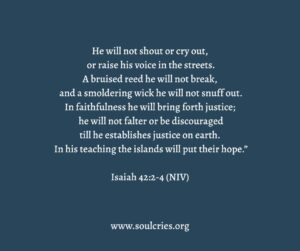
He will not shout or raise his voice in public. He will not crush the weakest reed or put out a flickering candle. He will bring justice to all who have been wronged. He will not falter or lose heart until justice prevails throughout the earth. Even distant lands beyond the sea will wait for his instruction.
Isaiah 42:2-4 NLT
This is Emmanuel’s invitation to you:
Then Jesus said, “Come to me, all of you who are weary and carry heavy burdens, and I will give you rest. Take my yoke upon you. Let me teach you, because I am humble and gentle at heart, and you will find rest for your souls.For my yoke is easy to bear, and the burden I give you is light.”
Matthew 11:28-30 NLT
This is Emmanuel’s promise to express fully the heart of the Father:
Jesus replied, “Have I been with you all this time, Philip, and yet you still don’t know who I am? Anyone who has seen me has seen the Father! So why are you asking me to show him to you?
John 14:9 NLT
Don’t delay in crying out to experience the Father’s heart of love and compassion toward you. If, like me, you have experienced the pain of church hurt, don’t assume those who hurt you represent the Father as Jesus proclaimed he would do. People fail. Jesus never fails. Accept his invitation today to come near.
May I pray for Jesus to come close to you?
Dear Lord Jesus, come near to this one today who desperately needs your attention. May they feel your peace and comfort, and may they see your glory and experience your love. In your name, amen.
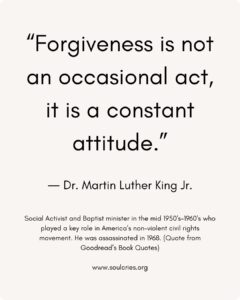
Forgiveness isn’t a word often used these days. And when it is, the pain we feel from the trauma or betrayal goes too deep to even consider. Yet, I’ve learned that stuffing doesn’t fix anything.
I’ve learned from experience that stuffing is not equal to healing. Eventually the stuffing begins to ooze out all over the place, much like that suitcase I filled too full. As my suitcase is jostled and dropped, it eventually busts wide open to expose everything I wanted to stay hidden.
BEFORE I BEGIN
I’m not a professional, and I understand that healing from trauma and betrayal may require time and professional help before forgiveness is possible. With that, I have experienced the internal peace that comes with forgiveness.
Also, if you currently live in trauma without safety, I pray that God would move on your behalf so you may see his care for you and experience his power at work on your behalf. Please don’t stay there once you see the way out!
I also pray that God grant you someone to help you navigate the pain you’ve endured so that you can begin to heal. If you have sought help and have had little relief, there are many stories of people whom God has healed from PTSD.
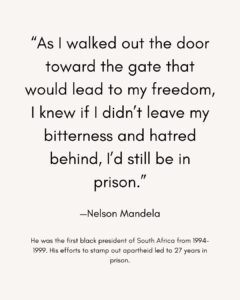
I too have experienced his healing from PTSD over time and have shared pieces of my story in other posts. Because of my own need in the last year to heal and make choices regarding forgiveness, I have done a lot of soul-searching and some study on forgiveness–what it is and what it isn’t. I have become greatly aware that to find healing eventually requires the choice to forgive. But first let me clarify what I mean by forgiveness.
Never means you need to stay with or return to the perpetrator so they can continue to abuse. Safety is never ignored by true forgiveness. (Church leaders should NEVER advise anyone to stay with an abusive spouse or parent in order “to submit and forgive”.)
Doesn’t assume a time-frame. (If the events caused deep emotional wounds or trauma, you may need outside help to process the events and your emotions/trauma to be able to forgive.)
FORGIVENESS ALWAYS ASSUMES
The perpetrator doesn’t deserve forgiveness.
The choice to forgive is for the benefit of one emotionally wounded or traumatized to find inner peace and healing.
“I refuse from this time forward to be emotionally enslaved to the one who traumatized me.” (Refusal to forgive keeps the traumatized emotionally chained to the perpetrator and events that traumatized.)
SCIENTIFIC STUDIES ON THE POWER OF FORGIVENESS
As I researched for this article, I found many quotes both for and against forgiving those who’ve deeply wounded you. I also read about overwhelming scientific evidence (abstract by NIH, Harvard Medical School, Johns Hopkins Medical School) that suggests that the choice to forgive benefits the forgiver.
Practicing forgiveness can have powerful health benefits. Observational studies, and even some randomized trials, suggest that forgiveness is associated with lower levels of depression, anxiety, and hostility; reduced substance abuse; higher self-esteem; and greater life satisfaction. Yet, forgiving people is not always easy. From “The Power of Forgiveness” February 12, 2021, Harvard Health Publishing, Harvard Medical School
Faith Gateway article from the book by Eric Metaxas, “7 Women and the Secrets of Their Greatness” entitled, “The Test Of Forgiveness.” The article is about Corrie ten Boom, an Austrian Holocaust Survivor whose family harbored Jews in their home before being caught and sent to the Ravensbrück concentration camp.
Maybe you’re thinking one of these scenarios right now:
“But I can’t forgive.”
“I’m still suffering from what they did to me.”
“What they did was too horrific to be forgiven.”
“They still don’t care about what they did to me.”
“But you have no idea what you’re asking me to do.”
To say I understand would be cruel. I can’t even list all I’ve faced and use my life’s experiences as reason for me to sit here and tell you I understand.
Yet, as I contemplate the events of my own life and the pain I’ve experienced even the last year, I’m realizing forgiveness plays a huge role in my ability to experience lasting inner peace and healing.
Please don’t throw out the idea of forgiveness without taking time to consider what you have read here. Forgiveness is meant for you to flourish.
BUT WHAT IF I’M THE ONE WHO NEEDS FORGIVENESS?
You aren’t alone. Every one of us, including me, have been in this place of needing forgiveness. That’s why God’s Word states that:
Christ suffered and died for sins once and for all–the innocent for the guilty–to bring you near to God by his body being put to death and by being raised to life by the Spirit. 1 Peter 3:18 TPT
I sat in the congregation while praise music blared as one-by-one young and old testified of their new life in Christ through baptism in the pool set up at the front of the church. Suddenly I noticed a middle-aged man I knew enter the pool followed by a young man whom the older man was readying to baptise. I had heard the story of how the older and younger had met and sat with tears streaming down my face as I witnessed extravagant love.
The older man and his wife had lost their son several years before to a drunk driver. They decided that rather than live in rage at what had happened, they would choose to forgive. Not only that, they decided they wanted to meet this young man who had squandered their son’s precious life through a moment of sheer stupidity and self-indulgence. They were granted permission to meet their son’s murderer, and share their hearts to forgive. They spent time with this young man over the next several years. Moved by their love, the young man decided to give his life to Christ. This particular morning, as both father and murderer stood together in the baptismal pool, a new family was born and hundreds got to witness extravagant love. Love like Jesus.
WHAT IF THE ONE YOU NEED TO FORGIVE IS GOD?
Talk to him about it. He’s seen your heart all along and would want you to dialogue with him about it. It won’t hurt, and could help. Also, if you’ve been wounded by someone who identified themselves with God, they aren’t God. There are plenty of people who misrepresent him every day. Talk to God about them as well. God longs for you to find restoration with him through Jesus.
STRUGGLING WITH THE PAIN OF FORGIVING
Corrie ten Boom was an Austrian Christian who’s family hid Jews during the Pogroms in Austria. Her father and sister died in concentration camps, and she survived Ravensbruck. This is her story of struggle:
BIBLE BITES REGARDING FORGIVENESS
“Who is a God like you, who pardons sin and forgives the transgression of the remnant of his inheritance? You do not stay angry forever but delight to show mercy.” —Micah 7:18
“If my people, who are called by my name, will humble themselves and pray and seek my face and turn from their wicked ways, then I will hear from heaven, and I will forgive their sin and will heal their land.” —2 Chronicles 7:14
“Be kind and compassionate to one another, forgiving each other, just as in Christ God forgave you.” —Ephesians 4:32
MAY I PRAY FOR YOU?
Father, I know what it’s like to hurt so badly that the thought of forgiveness makes me feel like throwing up. Yet, I’ve also felt the freedom of finally choosing to forgive. Would you please comfort this one who now struggles? Would you reveal your heart toward them and what they’ve been through? Would you come now and intervene on their behalf to help them do what they cannot on their own? Thank you, in Jesus’ name, amen.
Anxiety and depression often lock arms, and demand to be noticed; but I’ve discovered tools to help silence their intimidations. Among many other tools, learning to see the world from the vantage point of gratitude has been critical to my victories over these two bullies.
My story includes depression
After Gary and I married in 2012, he and his boys moved into my home as we began life together. As I mentioned in the last post, all four of us had been traumatized by the process of illnesses and deaths of our previous spouses, and so his boys were less than thrilled to be facing a new life with a new “mom” figure. Blending a new family takes time. It has been wisely stated that the process of blending families is more like a crock pot than a microwave. It’s true.
My now youngest son expressed his daily frustrations openly and the oldest was more inclined to passive aggression. Either way, I understood their frustration. Gary’s and my courtship had been long-distance, so I had only a handful of opportunities to get to know Gary’s boys before the wedding. I intellectually understood their pain, but my heart wept that wanting them in my life didn’t currently mean they wanted me in theirs.
Gary too was adjusting to our new family as he navigated the employment market in a new state at fifty-seven years of age. He had previously experienced decades of working in his father’s very successful and well-known electrical business with Kroger stores in four states. But his dad had died several years before leaving the business in decline, and now he tried to find work in a part of the country where his father’s business success meant nothing. He was starting over, and although he told me he would deal with the boys until our relationship had a chance to grow (a good idea in theory) his new job was way below his previous pay-grade and experience level which added tremendous stress to his life. I became the adult who most often interacted with the boys.
Tempers often flew and my formerly peaceful home of just me and the dog was no more. I expected Gary to step in, but his own grief and all they had been through together still overwhelmed them all. I felt very alone and invaded as depression began to set in. I daily struggled with my own trauma, compounded by anger and growing bitterness.
As our second Christmas rolled around, I wasn’t doing well internally. While looking through a book catalog one afternoon, a title caught my eye, and I knew the Lord was encouraging me to get the book. I ordered, “1000 Gifts” by Ann Voscamp, and soon after Christmas began reading it. I related with Anne’s journey with depression, and so her words soothed my aching soul.
God knew I needed this! Photos in this post are gratitude photos from that time period.
My education into defeating depression
What I learned from Anne, I now share with you. Her years of depression slowly lifted as she learned to practice gratitude. It sounds too simple, but as I also took up the practice, I too began to notice depression lose it’s hold. There were other measures I later took to keep depression at bay, but for now I’ll share how both Anne and I began this simple practice, and in the following posts I’ll speak to the other things I had to add. This practice is an amazingly simple tool that is critical to mental health.
Anne’s sister gave her a journal as a gift, and suggested she daily write down everything that brought her the smallest bit of pleasure and happiness. It became a game to see if she could discover 1,000 gifts to enter into the journal she now left open on her kitchen counter. She prayed that God would show her even the smallest pleasures so she could write them down.
For the first time, her eyes were opened to the beauty within the iridescent bubbles in her soapy dish water. She began to notice the pleasure she found in hearing the birds singing outside her kitchen window. She suddenly noticed the artistic way the shadows danced on the walls as the sun came through the open door. Her children’s laughter and childish conversations began to bring her pleasure rather than irritation. As her soul became alive to the simple beauties, depression slowly began to lift. Gratitude was displacing depression as God moved to heal her heart. She found such pleasure and joy she had never experienced, and soon began taking pictures of her discoveries. Her blog now contains her photos, and continues the dialog of her journey.
I’d never thought of looking for God’s gifts in such simple, daily pleasures. Until reading Anne’s book, if I noticed the bird songs at all, I didn’t think of being grateful. Being thankful for simple things like soap suds? But Ann’s transformation gave me hope. It wasn’t long that hope drew me to place my own open journal and pen on the kitchen island to await my own record of gratitude discoveries. I too soon added a growing number of photos to remind me over and over of new found simple pleasures. And as my list grew, I too felt depression’s fangs withdraw from my being.
Grateful for an evening walk holding hands with Gary
‘Often people ask how I manage to be happy despite having no arms and no legs. The quick answer is that I have a choice. I can be angry about not having limbs, or I can be thankful that I have a purpose. I chose gratitude.’ – Nick Vujicic
Depression, gratitude, and science
Neuroscience of gratitude article
Neuroscience has discovered that there are several long-term benefits of practicing gratitude through giving simple thank-you notes and keeping a gratitude journal. An article in PositivePsychology.com entitled, “The Neuroscience of Gratitude and the Effects on the Brain” states that the effects of regularly expressing gratitude:
Activates the reward centers of the brain enhancing feelings of well-being and contentment while also encouraging cognitive restructuring making it easier to think positively
Rewires the brain to fire new connections to the bliss center (see also information from the previous post by Dr. Caroline Leaf regarding rewiring the brain)
Reduces fear, depression and anxiety through regulating the stress hormones while enhancing dopamine and serotonin transmitters responsible for happiness
There are also beneficial effects on the body, including:
Activation of the portions of the brain that regulate emotions, body functions, and memory allowing those who regularly practice gratitude to heal faster and feel better sooner compared to those who strictly focus on their negative experiences
Increased vitality and thereby decreased symptoms of pain
Improved deep and healthy sleep, with increased opportunities to feel refreshed upon waking
Making a habit out of expressing gratitude also improves social bonds and increases the possibilities for positive social outcomes in the future.
Grateful for clean dishes and a dishwasher to clean them
…. a light expression not necessarily conditioned to good times, making it possible to maintain the feeling and feel good, even during negative experiences or most difficult moments.
The studies referred to in the NIH article included gratitude interventions such as:
Gratitude diaries
Conversation programs
Training and visits
Expression of gratitude to others (verbally or in writing)
Publishing pictures with captions of gratitude
Thinking of things that makes one feel grateful
The studies this article focused on showed that a habit of expressing gratitude positively improved:
Satisfaction with life
Mental health by decreasing the symptoms of anxiety, depression, and Generalized Anxiety Disorder (see also my last article on anxiety regarding how Dr. Caroline Leaf has discovered that changing the way you think changes the “root” structure of the brain)
Feelings of optimism and positivity
Prosocial behaviors
Sleep patterns (in one study significantly, and in another study no measurable improvement) There are other factors that affect this, which I will write about in a future article
This practice isn’t one and done. It has to be regularly maintained. I have found that since making the practice of gratitude a priority, I notice God’s daily gifts more readily. I have also discovered that when I’m focusing on a current problem my ability to notice his gifts diminish.
The reason I attribute simple daily pleasures to God is because I have experienced his goodness and know that he is the author and giver of all such gifts. I thank him, because my heart longs for him to experience the pleasure of having truly blessed me.
Every good and perfect gift is from above, coming down from the Father of the heavenly lights, who does not change like shifting shadows.
James 1:17
Surprise gift of steamed Blue Crabs from a friend!
Bible bites regarding depression and gratitude
“The Spirit of the Lord is upon me, for he has anointed me to bring Good News to the poor. He has sent me to proclaim that captives will be released, that the blind will see, that the oppressed will be set free, and that the time of the Lord’s favor has come.” Luke 4:18-19 (NLT)
Let me pray for you
Lord, this one reading this post needs your touch. You promise that all who come to you will never be turned away. You promise never to batter them as they have experienced in the world. You promise not to extinguish what light that remains, but desire to give them life like they can’t even imagine. Peace like they only dream of, and hope they have come to think doesn’t exist. Holy Spirit do what only you can do. Surprise them by your power and love toward them. In Jesus’ name, amen.
One man’s testimony of the power of gratitude to pull down depression
Anxiety. That sense of electricity uncontrollably coursing through my body. Feeling like I want to crawl out of my skin but can’t. Agitation I can’t walk away from. It’s tormenting.
In 2007, as I faced my husband’s impending death, anxiety struck the first time like lightning. The storm lasted six to eight years, striking multiple times daily, every day like poor Ned Ryreson reliving Ground Hog Day. It took time to understand what in the world I was experiencing, and that I wasn’t going mad. It also took a lot of time for God to instruct me how to harness anxiety and restore peace.
It’s been a while since I have dealt with anxiety like I did in those days. I’ve experienced small squalls since, but within the last several months, anxiety has tried to batter me once again to where I’ve wanted to crawl under a rock and escape. Once again faithful God is teaching me how to subjugate this beast and restore peace. Since we all have moments when anxiety and fear rage, allow me to share with you pieces of my journey and my transformations to peace.
I’m not a professional but do know anxiety
I have a lot of experience with anxiety over many years, and it is from that pool of experience that I write and remind myself of how far I’ve come.
As I researched this post, I learned of Dr. Caroline Leaf, a Neuroscientist who has spent her career studying the plasticity of the brain. She states that anxiety and its associated emotions aren’t meant to be accepted as “normal” forever, but to be tools to expose areas of our lives needing assistance so we can live healthy lives.
Our culture is obsessed with Social and digital media as we crave greater amounts of information. Yet, with all we allow ourselves to take in daily, both pleasant and stressing, society in general is beginning to show signs that something is wrong.
“The use of social networks is strongly correlated with the development of anxiety and other psychological problems such as depression, insomnia, stress, decreased subjective happiness, and a sense of mental deprivation.”
Neuroscientists are learning that unbridled negative emotions/circumstances and their corresponding thought patterns build toxic pathways in our brains much like deformed roots and branches of a tree. In addition, they are also learning that we can retrain our brains to shut off the spiraling thought patterns that help produce chronic anxiety and depression.
We all have choices, and can choose patterns that avoid or heal chronic anxiety. Who and what I listen to is critical for my mental health and for retraining my brain toward more healthy pathways. If the majority of my intake only encourages and affirms my anxiety, depression, and negativity, I’m feeding myself poison.
I was recently told that someone, whom I love deeply, realized that much of her anxiety was caused by what and who she listened to, and that once she stopped all the toxins coming in, she began to see life with greater positivity. Several of the above reports suggested limiting social and digital media usage in order to improve mental health.
After my first husband’s death in 2008, what I listened to helped to decrease grief and anxiety
Instead of listening to music that “understood” and “affirmed” my grief and anxiety, I chose music that reminded me that I was understood and upheld by the God who made and loved me, that I didn’t walk alone, and that God had good plans for my future. Rather than becoming further depressed, the music improved my mental health. I’ve heard many testimonies from others who also chose to listen to Christian music for 30 days, and that it changed their outlook on life. KLOVE is an excellent starting point.
I made time to sit with my pain and acknowledge the loss with Jesus as my companion, rather than allow anxiety and grief to spiral over and over in my head. I listened to Jesus’ voice and comfort over focusing on the grief, anxiety, and loss I felt. The space I made to grieve allowed me to heal sooner, and offered me greater peace as I navigated this new season of life.
I surrounded myself with people who could offer hope and instruction as to how to navigate this new stage of life. I attended a local GriefShare group that surrounded me with people who understood. The accompanied grief training also taught me that my grief experiences were normal, and helped me navigate this new life with greater peace. Both the people and training equipped me to understand my grief so I could heal, offering less space for anxious thoughts to take precedence. GriefShare has chapters throughout the US and also has a web presence if you live outside the US.
After remarrying in 2012, a trauma counselor helped tremendously with anxiety
My newly blended family struggled with the traumatic loss of their former wife and mom two years before. Also, I was now the third mom to not only my adopted son, but now two step-sons who had also been adopted. Life wasn’t easy for any of us as we navigated to blend our family. in addition, I continued to deal with the anxiety associated with my first husband’s death. Pain clashed with pain and sometimes triggered old wounds and created new ones.
I finally realized I needed assistance to work through the trauma, and so my pastor recommended a Christian trauma counselor. She affirmed the trauma by acknowledging that I wasn’t exaggerating the struggles. She also spoke truth, hope, and life into our situation, and gave me sound advice as to how to express my heart, needs, and emotions so my husband could better understand. This time with her gave me tools, hope, and a healthier way forward, and broke down opportunities for anxiety to continue to rule.
After about four years of marriage, things began to calm down significantly, and I had healed enough that the anxiety no longer had a hold on me. I was grateful for the morning I awoke, and anxiety wasn’t the first emotion I experienced. I was finally beginning to feel safe.
During COVID we invented new practices to guard against anxiety
Covid, for the most part, is behind us. Yet the effects are still among us. What I learned from that time still affects what and who I listen to today.
I cut off most of the news and social media as it was having a negative impact on my mental health. I still hold to this practice. My life is much more fruitful because I don’t spend hours listening to and reading about things I have no control over. So when I interact with the pain of others within my world, I have a greater pool of energy and compassion to give. My impact is increased because I’ve not given my emotional energy to things outside my sphere of influence.
My husband and I began a practice then that we still hold to today – we often spend time near the end of the day listening to and singing contemplative worship and praise music that lifts our eyes from the events of this world to God’s realm among us. It calms and soothes me from the effects of daily life, and often eases any anxiety that I may be facing with his peace.
The role the Bible plays in my mental health
Reading my Bible daily is critical to my mental health. Below are some helpful steps to begin and maintain a reading plan:
Pray for God to reveal his love for me
Don’t begin with Genesis or Matthew
Good starting places – the Psalms (reveals God’s understanding and compassion) and the gospel of John (reveals God’s love and power through Jesus)
Read a newer translation such as the NIV or NLT. King James was a wonderful translation for its time, but the archaic language makes it difficult to understand today
Read until something about God’s love, or a positive course change sticks out to you. That may be God speaking to your heart
Respond to what you read – Pause, consider, record what you recieved, and talk to God about it
A taste from God’s Word
The Bible simply speaks to the wisdom of guarding what I allow into my mind, and the positive benefit of doing so:
…whatever is true, whatever is noble, whatever is right, whatever is pure, whatever is lovely, whatever is admirable—if anything is excellent or praiseworthy—think about such things. Whatever you have learned or received or heard from me, or seen in me—put it into practice. And the God of peace will be with you. Philippians 4:8-9 (NLT)
A Prayer of Hope
Lord, you have brought great healing into my mind, body, and spirit, so I ask you to do the same for this dear one. Your love for them surpasses knowledge. May you grant them the trust they need to reach out to you. In Jesus’ name, amen.
Interested in a brilliant, mobile responsive website that converts?
We can make that happen.
Stormhill Media is a web design and social marketing company with the goal to provide you the best and most affordable website solutions for your online brand.














Recent Comments